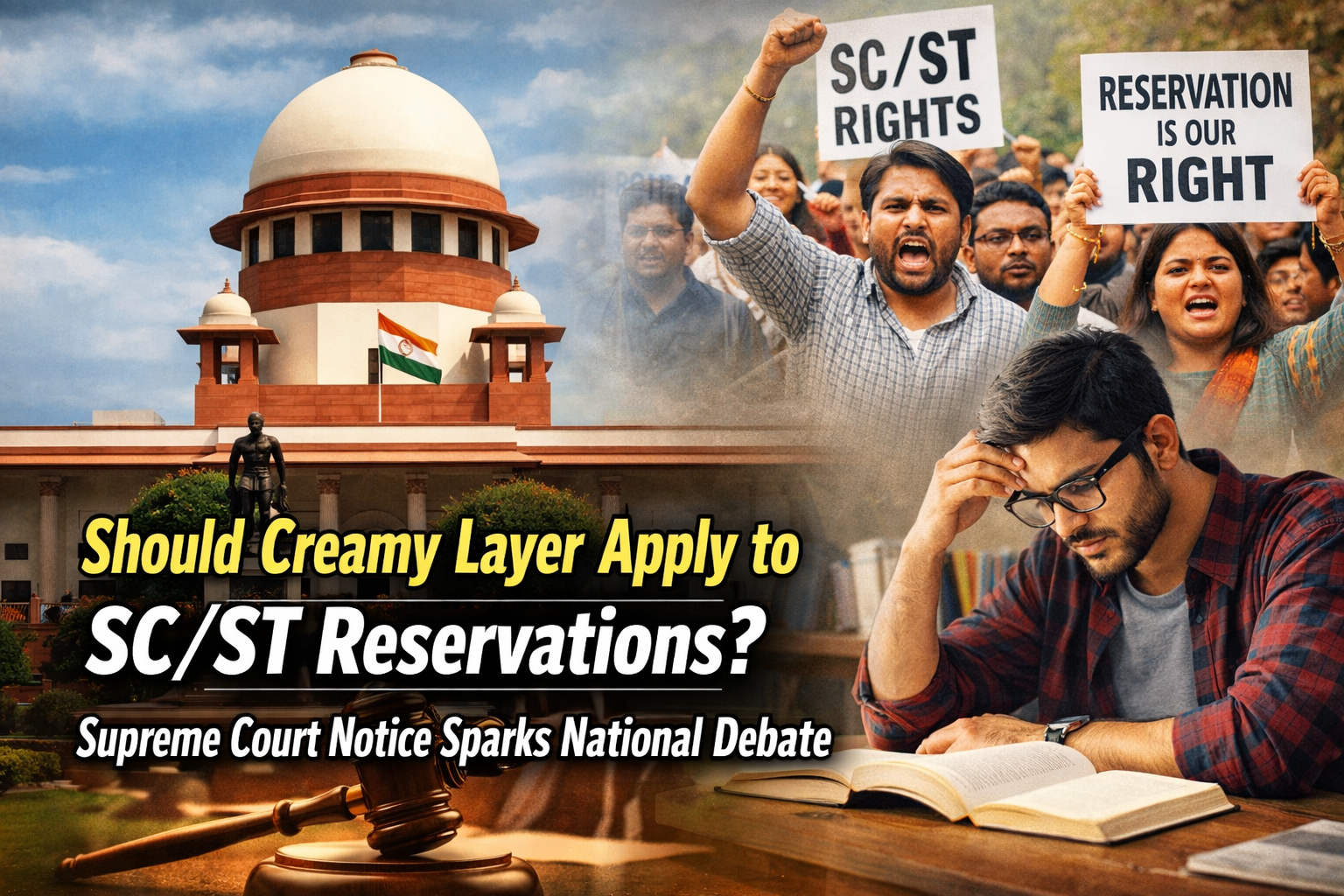
In a major development, on 14 February 2026, the apex court of India, the Supreme Court of India, has issued a notice to the central government regarding the creation of a creamy layer system in SC/ST quotas. The creamy layer system exists in OBC reservations; it provides a safeguard to the poor and marginalized sections within the OBC community. OBC reservations have been an issue of contention in various states such as Madhya Pradesh, Chhattisgarh, Uttar Pradesh, and Puducherry. The electoral aspects of it have made political parties keen to provide it.
As per current norms, the creamy layer income limit for OBCs is ₹8 lakh per annum. According to Census 2011 data, Scheduled Castes constitute 16.6% and Scheduled Tribes constitute 8.6% of India’s population, while OBCs are estimated to form around 40–50% of the total population.
OBC reservations have not been very successful in providing opportunities to the poorest of the poor. Hence, the creamy layer concept was a great innovation to prevent the rich from encroaching upon opportunities meant for the marginalized. However, applying the creamy layer system to SC/ST quotas without detailed analysis could prove disastrous, as there is an aspect of affirmative action associated with it.
Creamy Layer
Creamy layer is a concept that defines the upper limit of OBC reservation. People above it are not entitled to reservations in jobs and educational institutions, while people below it are.
Creamy layer is determined by income, family background, among other criteria. Like the EWS reservation, it excludes people and families who are well-off from benefiting from reservations that are meant for weaker sections within the category.
Constitutional Position
In the reply to this notice, the central government can state that the concept of creamy layer is not enshrined in the Constitution for SC/ST quotas. It is true that the original Constitution does not have any mechanism of this sort, but it did not have OBC reservations either. OBC reservation was introduced by the government of V. P. Singh in 1989–1990.
Nevertheless, the Constitution speaks volumes about providing opportunities to the poor and marginalized sections of society. The Directive Principles of the Constitution have clauses in support of it.
Affirmative Action
Historically, reservations were introduced as a means of affirmative action for the historical wrongs and social exclusion of these communities. Reservations were initially meant only for the SC/ST communities.
Later on, there were demands to create another category for communities who were left behind in development and social progress. This led to the introduction of OBC reservations and the EWS reservation, which are meant to provide for the backward classes and economically weaker sections, respectively.
Former CJI B. R. Gavai had also supported the idea of creating the creamy layer within the community in order to ensure that the benefits go to the poor and underprivileged sections within the SC/ST communities.
Impact of Creamy Layer
The introduction of the creamy layer in SC/ST reservations will positively impact the overall progress of the communities, as envisioned by the Constitution makers.
It is ethically wrong that children of politicians, bureaucrats, ministers, MPs, and MLAs are entitled to the benefits of reservation even after being well-off. This is an injustice to the last person in line, as he fails to get a good job and finds himself stuck in a vicious cycle of poverty.
The creamy layer would ensure that this injustice comes to an end and would pave the way for the betterment of these communities. Such measures are not alien and are already working in the case of OBC and EWS reservations.
OBC Reservation
India has a large population to cater to; the OBC category constitutes roughly half the population of India. If these measures were not there, we would end up giving reservations to almost seventy-five percent of the country. This would have dissolved the benefit and significance of reservations themselves.
Conclusion
Reservations are not only used for betterment, but politics has ensured their use for electoral gains. Various communities that are dominant and rich are added to the folds of reservations for political gains.
Seats for meritorious students are getting fewer day by day; this hurts the meritocracy in India. Instead of bridging gaps, reservations often create division in society.
Such measures ensure the success of affirmative action. The brutal reality is that even after decades of reservations, the condition of SC/ST communities is still grim. The poor are barely making it into the education system or getting the job opportunities that they truly deserve.
The central government must respond in this regard with detailed analysis and commit to the benefit of the marginalized.
Abhinay Shukla is the founder and editor of The Indic Way. He writes on public policy, constitutional matters, civilizational thought, and contemporary socio-political issues, focusing on the intersection of tradition, governance, and modern India.