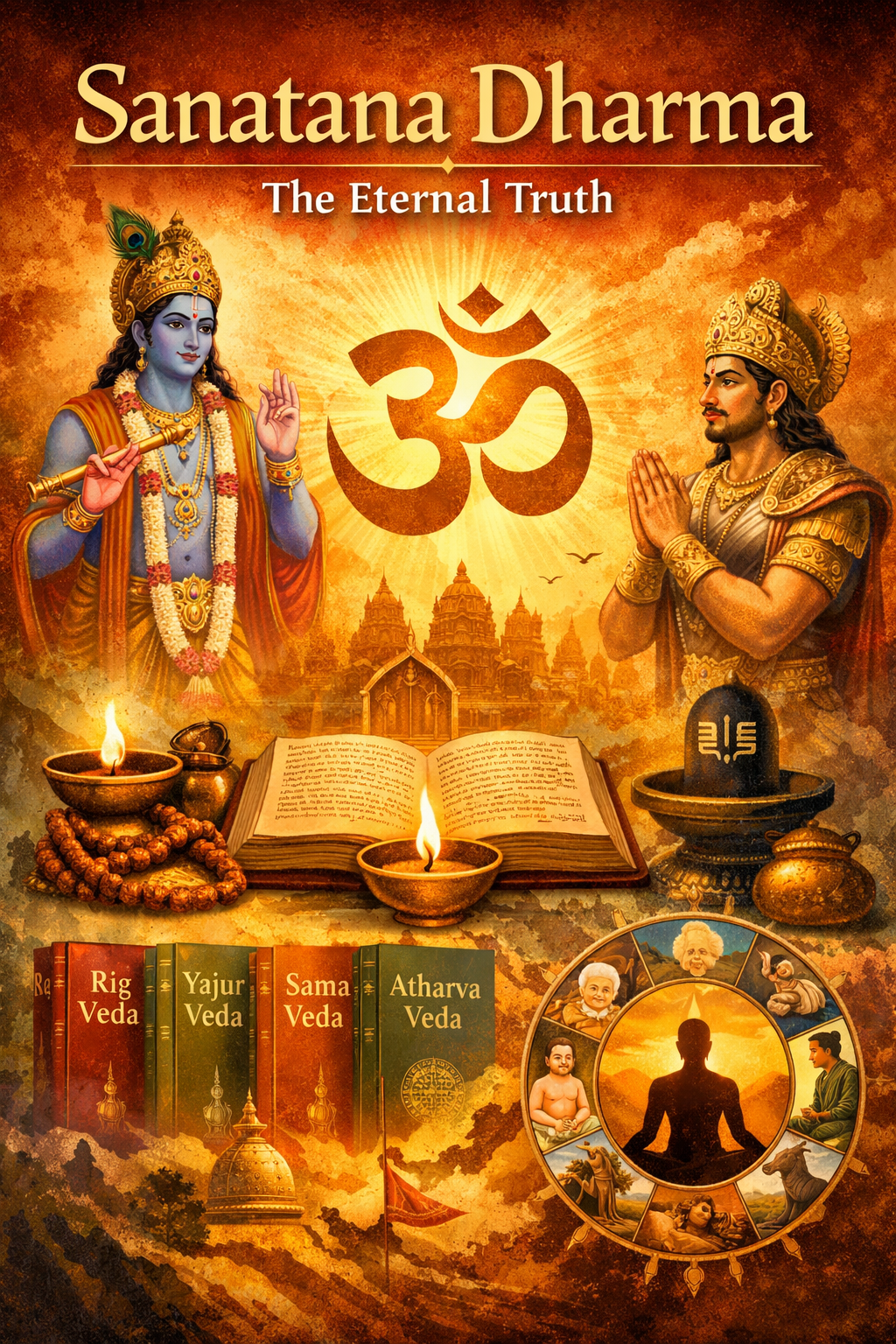
Many a times when we hear the word Sanatana Dharma, we either confuse it with something else or we tend to ignore it as a complex Sanskrit expression. But it is neither complex nor confusing. The simple meaning of this Sanskrit expression is eternal religion. Here the word religion is interchangeable with duty, law, or righteousness.
In the Bhagavad Gita, Lord Shri Krishna explains the meaning of swadharma, dharma, and raj dharma. Swadharma means the moral obligations or duties upon oneself, while dharma has social connotations. Rajdharma simply means the law or duty of the state or kings toward their country or subjects.
Meaning of Sanatana Dharma
Dharma means the eternal and moral way of life. It is the ability of judging right and wrong. Sanatana simply means timeless.
Hence, Sanatana Dharma is nothing but timeless law in simple terms.
Is Sanatana Dharma the Same as Hinduism?
Many a times we use Sanatana Dharma interchangeably with Hinduism, and it is also not entirely wrong. One can use the two words interchangeably as they both refer to the same cosmic law or way of life.
The word “Hinduism” has Persian origins, according to historians. Persians used to call the people living across the Sindhu River and under the Himalayan mountain range as Hindus.
Hinduism originates from a Persian expression, while the indigenous name was Sanatana Dharma. Hence it may be correct to use them interchangeably, but not without knowing the meaning of both the expressions.
Origin and Historical Background of Sanatana Dharma
Sanatana Dharma, as evident from its name, is timeless. However, its philosophical foundations can be traced in the Vedas, which scholars generally date between 1500 BCE and 500 BCE.
The Vedas are considered the supreme authority texts in Sanatana Dharma alongside the Upanishads.
In Manusmriti, there is an explanation that before dharma, there was chaos in the world. It was dominated by matsyanyaya, which means the big fish eating the small fish.
In other words, the stronger ruled over the smaller and weaker. Sanatana Dharma ended this misrule through the establishment of cosmic law or dharma.
Lord Krishna on Dharma
To further provide protection to dharma, Lord Krishna says in the Bhagavad Gita:
“Yadā yadā hi dharmasya glānir bhavati Bhārata,
abhyutthānam adharmasya tadātmānaṁ sṛijāmyaham.”
Meaning, “Whenever dharma declines, O Bharata (Arjuna), and unrighteousness rises, I manifest Myself.”
Texts of Sanatana Dharma
The Vedas are the central authority which provide the ritualistic aspect of dharma, while the Upanishads provide the spiritual and metaphysical aspects of it.
The Vedas are four in number, namely:
- Rigveda (considered the oldest)
- Yajurveda
- Samaveda
- Atharvaveda
These contain the early hymns, rituals, and philosophical foundations of Sanatana Dharma.
Core Beliefs of Sanatana Dharma
Like every philosophy, Sanatana Dharma also has a set of central ideas or core beliefs. Some of them are:
Law of Karma
Karma simply means actions. It is one of the most important aspects of Sanatana Dharma. A person’s future and final attainment depend upon the actions of his life. Sanatana Dharma prescribes that one must examine his actions and follow his duty.
Now the concept of swadharma, or one’s own duty, becomes crucial here. Shri Krishna states in the Gita that one must never abandon his own duty.
In the West, it is often assumed that the law of karma means “what goes around comes around,” but that is a simplified explanation. The concept teaches that one must fulfill his duty according to dharma, or else face consequences.
Goal of Moksha
Moksha is the final attainment of the soul in Hinduism or Sanatana Dharma. One who lives according to dharma may attain moksha.
Moksha in this context means freedom from the cycle of birth and rebirth. It represents spiritual liberation.
Rebirth and Cycle of Life
Sanatana Dharma believes in the cycle of life and rebirth. Its scriptures depict that the soul is the most subtle and eternal entity connected to the supreme reality.
According to Garuda Purana, a soul takes many births in different life forms such as insects, reptiles, animals, and finally human beings.
Human life is considered the highest life form; hence it must not be wasted by engaging in unlawful or adharmic activities. It is important for human beings to follow the cosmic and eternal law.
Why Sanatana Dharma Is Relevant Today
It is true that the modern world is full of suffering and unrest. Sanatana Dharma provides guidance through its philosophy of contentment, peace, and coexistence.
It symbolizes eternal truth and encourages modern human beings to follow the path of righteousness and lawful duty.
Our minds are often influenced by material and market-driven pressures. A dharmic philosophy becomes important to understand the deeper meaning of human life.
Sanatana Dharma does not teach divisions or conflicts, but promotes unity, responsibility, and duty.
Frequently Asked Questions (FAQs)
1. Is Sanatana Dharma different from Hinduism?
Many a times people think Sanatana Dharma and Hinduism are different, but it is not exactly so. Hinduism is a word of Persian origin used for people living across the Sindhu river, while the indigenous name of the tradition is Sanatana Dharma. Both refer to the same eternal and cosmic law, hence they can be used interchangeably, but one must know their meanings.
2. What is the main goal of Sanatana Dharma?
The main goal of Sanatana Dharma is attainment of moksha. Moksha means freedom from the cycle of birth and rebirth. A person who follows his swadharma and lives according to dharma, fulfilling his duties, ultimately moves towards spiritual liberation.
3. What does Bhagavad Gita say about protection of Dharma?
In the Bhagavad Gita, Shri Krishna clearly states that whenever there is decline of dharma and rise of adharma, He manifests Himself to restore the cosmic order. This shows that dharma is not just a belief but an eternal law that is protected and restored whenever needed.
Abhinay Shukla is an independent researcher and writer focusing on Indian history, polity, culture, and civilizational studies. He writes at The Indic Way with the aim of presenting Sanatana Dharma and Bharat’s intellectual traditions in a clear and research-oriented manner.


4 thoughts on “What Is Sanatana Dharma? Meaning, History, and Core Beliefs Explained”