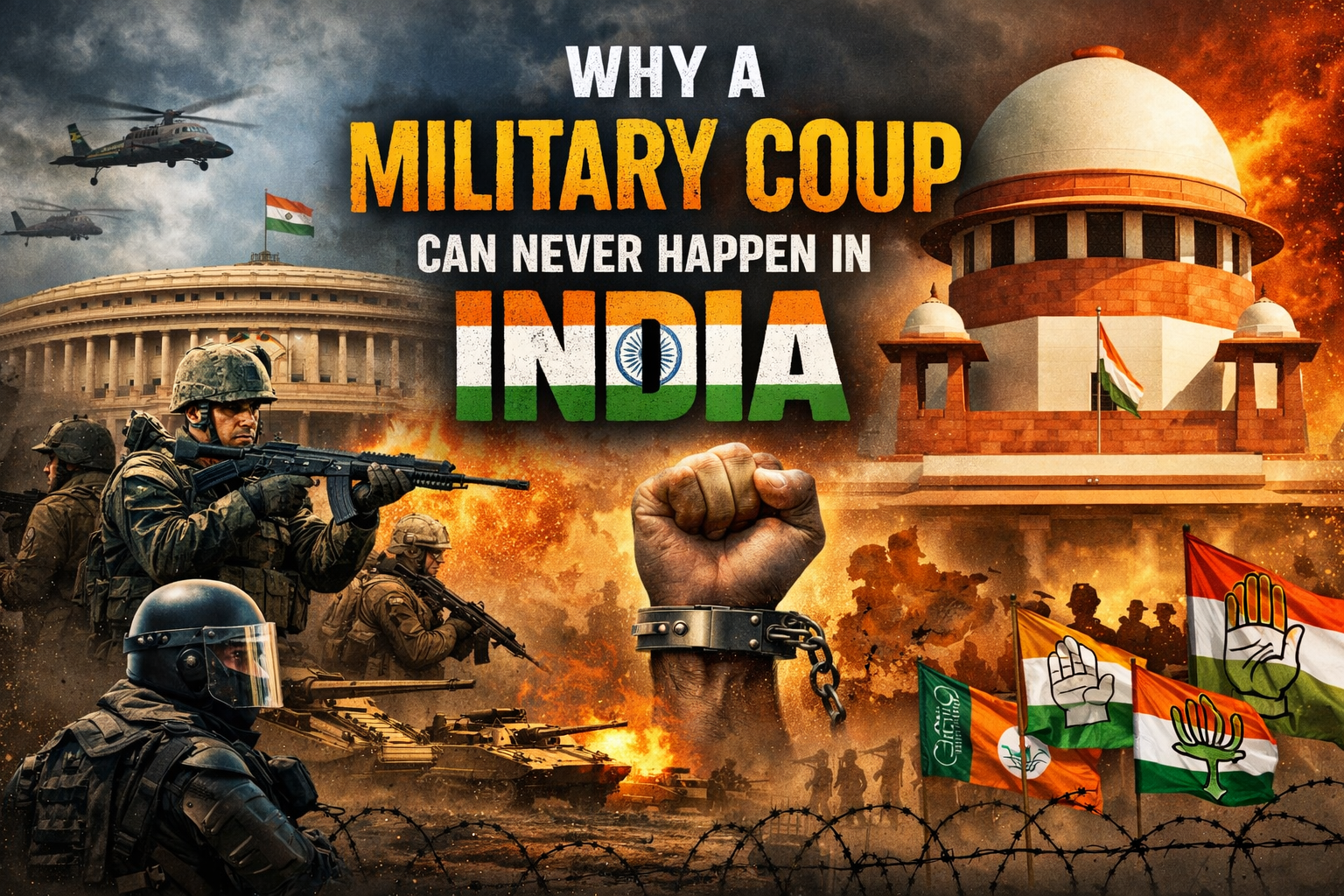
We have seen many countries falling into military coups or junta governments over recent years. there is living examples of Myanmar, Sudan, Thailand, and Pakistan.
We all speculate whether such a thing can ever happen in India or not. Or in other words, can the Indian government ever be surpassed by the military leadership of the country?
Well, our forefathers were astute politicians. They knew that for a new democracy, anything was possible. Such situations during that era were quite common in other countries of Africa and Asia.
India is a country that became a republic after fighting a century-long war of independence. This struggle has shaped the foundation of our democracy. We have seen it all — from the Emergency, terrorist attacks, dysfunctional governments, policy paralysis, etc. — but we as citizens had full faith in our democratic setup. We never expected our military to assume leadership.
India’s Constitution makers created enough mechanisms to check this kind of trampling of democracy. There are multiple institutions and safeguards in place that would always prevent India from being taken over by the military.
Five Strong Reasons Why a Military Coup Can Never Take Place in India
(1) Robust Paramilitary
India has a paramilitary strength of over 10 lakh personnel, including forces like CRPF, BSF, CISF, ITBP, and others, making it one of the most powerful internal security systems in the world.
In a scenario of a military coup, it is crucial to take hold of the sitting Prime Minister. India, being a democracy, always has a popular PM. A military coup can only be successful if the PM is at least removed, if not captured.
However, it is nearly impossible for the military to even think about this, as the Prime Minister is protected by the Special Protection Group (SPG), one of the most trusted protection forces in the world for constitutional dignitaries.
(2) Powerful Judiciary
The Indian Constitution gives immense power of checks and balances to the Supreme Court of India and the High Courts. Even the slightest constitutional violation invites judicial review.
Historically, the Indian judiciary has stood against unconstitutional actions. Even during the Emergency period in 1975, the judiciary functioned as an important pillar of democratic values.
Similarly, any attempt to undermine constitutional order today would immediately face judicial intervention.
(3) Federal Structure
The Indian political system gives significant importance to states — not just as administrative units but as separate constitutional entities. The Supreme Court has clarified that states have autonomy within their constitutional spheres.
The federal structure ensures that power is distributed. In the event of any unconstitutional takeover attempt, state governments would play a major role in resisting it.
(4) Political Parties
India has a diverse political spectrum with hundreds of registered political parties. This reflects India’s strong democratic culture.
Political parties and leaders across ideologies would never allow the military or bureaucracy to take over a democratically elected government. During the Emergency, many leaders went to jail under MISA but continued to resist constitutional wrongdoing.
(5) Constitutional Provisions
Article 34 of the Indian Constitution mentions martial law. However, it does not give power to the military to assume governance. Instead, it empowers Parliament to deal with situations where martial law may be imposed.
The Constitution contains several safeguards that protect democratic governance and prevent unauthorized concentration of power.
Conclusion
Looking at examples of countries like Pakistan, Sudan, and Thailand, one can clearly see structural differences between those systems and India.
A military coup in India is extremely unlikely due to strong institutions, a powerful paramilitary system, an independent judiciary, a federal political structure, and constitutional safeguards.
Moreover, India has a citizenry deeply committed to democracy and constitutional values.
We also have a robust media that acts as the fourth pillar of democracy, regularly questioning and criticizing those in power, including the government and the military.
In my opinion, a military coup could never be allowed to happen in India because the system, the institutions, and the people themselves would resist it.
Abhinay Shukla writes on Indian polity, national security, and civilizational issues with a focus on constitutional values and institutional strength. His work examines how India’s democratic and security frameworks have evolved uniquely compared to many other nations.
89fgamedownload… Hmm, new name to me. Checking it out now. Hoping for some smooth downloads. Wish me luck 89fgamedownload!