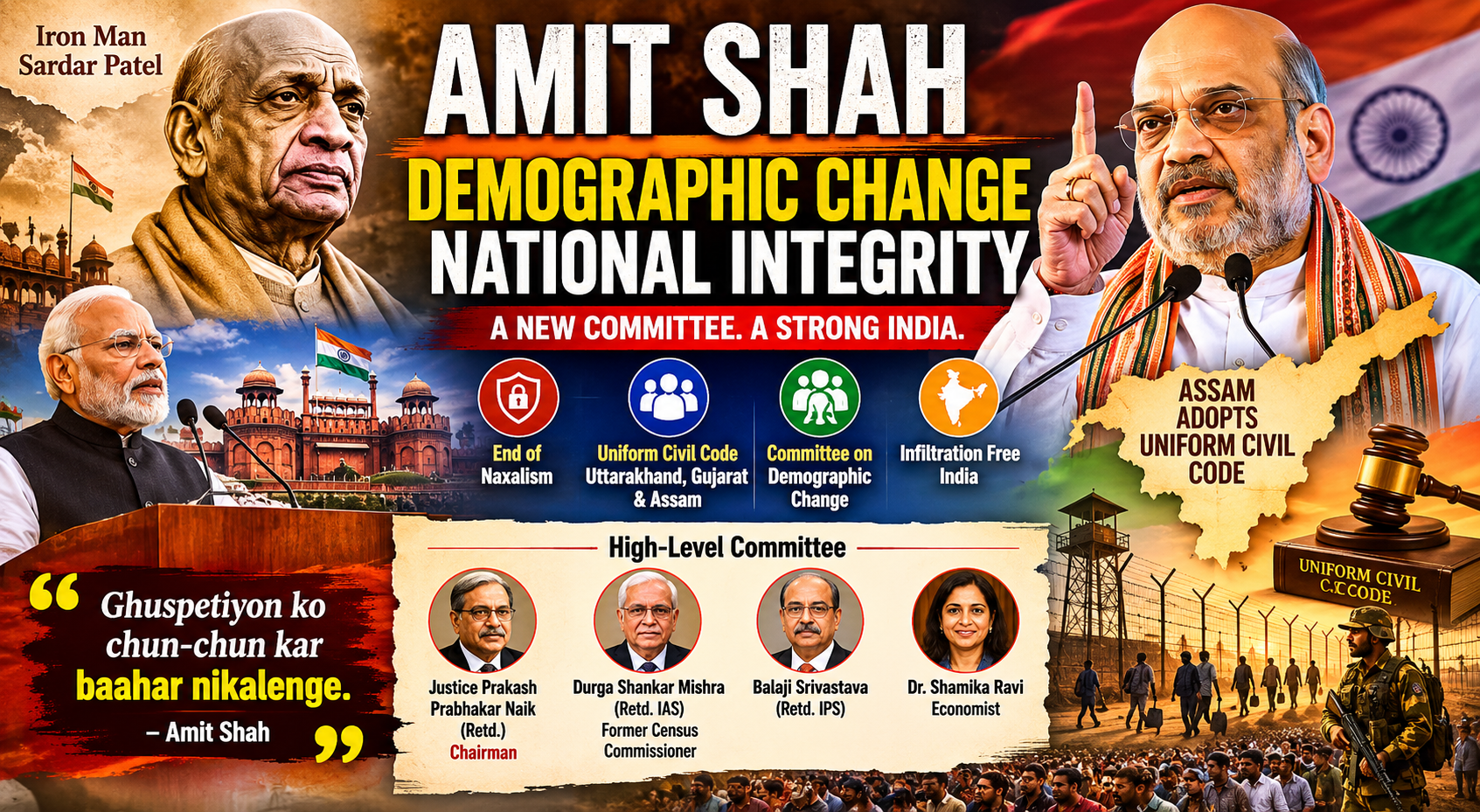
There is a view among many Indians that certain similarities can be seen between Sardar Vallabhbhai Patel and Amit Shah. Both leaders hail from Gujarat and are often perceived as firm administrators with a strong focus on national integrity and internal security. Just as Sardar Patel earned the title of the “Iron Man of India” for his decisive role in integrating princely states into the Indian Union, Amit Shah too is regarded by his supporters as a leader known for taking tough decisions on issues related to infiltration, terrorism, and national security.
Over the past several years, Amit Shah has consistently projected a hardline approach on matters concerning internal security and infiltration. The Union Home Minister has repeatedly emphasised the government’s commitment to creating a safer environment for Indian citizens, free from terrorism, separatism, infiltration, and extremist violence. Recently, he stated that the government has made significant progress in eliminating Naxalism from large parts of the country.
Now, Amit Shah is once again in the headlines after announcing the formation of a high-level committee to examine issues related to infiltration and demographic changes in certain regions of India. Through a post on X, formerly Twitter, he informed that the Ministry of Home Affairs would constitute a committee under the leadership of a former judge to study concerns surrounding illegal infiltration and demographic developments.
Notably, Narendra Modi had announced from the Red Fort on 15 August 2025 that a high-powered demography mission would be established to look into the issue of unnatural demographic change in the country. In what is being viewed as a step towards fulfilling that promise, Amit Shah has now constituted this committee to examine demographic changes occurring in different regions due to infiltration and other abnormal reasons.
The committee will be chaired by retired Justice Prakash Prabhakar Naik. Other members include former Census Commissioner Durga Shankar Mishra, retired IPS officer Balaji Srivastava, and economist Shamika Ravi.
According to a document issued by the Press Information Bureau, the committee will conduct “a comprehensive assessment of the demographic changes occurring across India due to illegal immigration and other abnormal reasons.” The formation of the committee has already triggered a wider political discussion on national security, illegal infiltration, migration, and demographic balance.
Amit Shah has long maintained that demographic change should not happen unnaturally. Migration for employment, education, or urbanisation is a natural phenomenon in any society, but concerns regarding illegal infiltration and rapid demographic shifts in sensitive regions have increasingly become part of India’s political discourse. Supporters of the BJP argue that unchecked infiltration and politically motivated silence over such issues can create long-term socio-cultural and security challenges for the country.
The issue has also remained closely linked to one of the BJP’s long-standing political promises — making India infiltration-free. Amit Shah himself had once famously remarked that “ghuspetiyon ko chun-chun kar bahar nikalenge,” underlining the seriousness with which he approaches the issue of illegal infiltration and demographic change.
At the same time, the BJP government has continued pushing for legal and administrative uniformity across states through the implementation of the Uniform Civil Code (UCC). Recently, Amit Shah congratulated the people of Assam after the state moved ahead with implementing the Uniform Civil Code. Assam has now joined Uttarakhand and Gujarat among the states that have taken concrete steps towards implementing a common civil framework dealing with matters such as marriage, divorce, adoption, and inheritance.
Supporters of the UCC describe it as an important step towards ensuring equality before law and maintaining uniformity among all citizens irrespective of religion or community. Under Amit Shah’s tenure as Union Home Minister, three BJP-ruled states have moved ahead with fulfilling the party’s long-standing promise regarding the Uniform Civil Code, something many within the NDA consider a milestone linked to national integration and administrative uniformity.
For now, the NDA leadership appears determined to keep issues of socio-cultural importance, infiltration, national security, and demographic balance at the centre of public discourse. With Amit Shah continuing as one of the BJP’s principal strategists and decision-makers, supporters believe these issues will continue receiving prominence in the coming years.


Kitchen set furniture European style cabinets Tampa Bay