From Socialist Ideals to Dynastic Politics — Five Major Concerns That Could Damage His Legacy
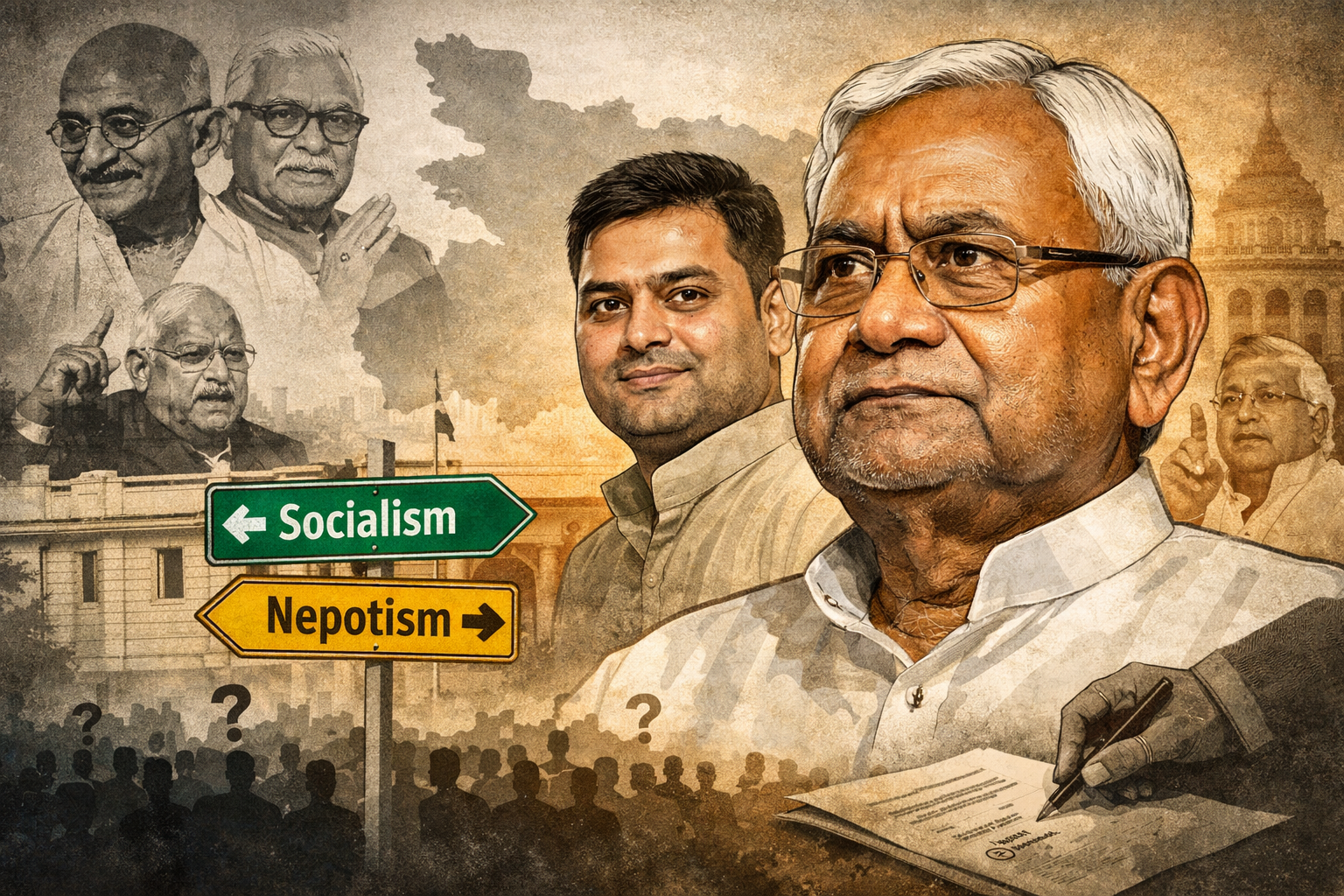
Nitish Kumar has always championed himself as a leader of the masses. He has projected himself as a leader who has risen through the ranks with the ideology of socialism. His socialism is greatly inspired by Mahatma Gandhi and Jayaprakash Narayan.
Alongside leaders such as Mulayam Singh Yadav and Lalu Prasad Yadav, he was known to be associated with this ideology of socialism.
However, there is now news that Nitish Kumar might step down as the Chief Minister of Bihar and make his son Nishant the Deputy Chief Minister. This possibility has surprised many political commentators.
For years, Nitish Kumar sharply attacked Lalu Yadav for his family’s involvement in politics and for promoting nepotism. Therefore, such a move would place him in stark contrast to the very politics he criticized.
The socialism of JP and the idea of nepotism are ideological enemies. If Nitish Kumar steps down to promote his son in the administration of the state, it would appear contradictory. Below are five major concerns that make such a decision politically risky.
1. The Shadow of Nepotism
Indian politics has long witnessed the phenomenon of nepotism or political succession. In many parties, a father or a senior leader makes way for the younger generation of his own family.
From national parties like the Indian National Congress and the Bharatiya Janata Party, to regional outfits like the Samajwadi Party and the Rashtriya Janata Dal, almost all major political parties in the country have faced accusations of nepotism in appointments.
So far, Nitish Kumar’s Janata Dal (United) has not openly promoted dynastic politics. That has been one of his distinguishing political strengths.
However, if Nishant Kumar is elevated to the post of Deputy Chief Minister, it may clearly appear as nepotism among voters. Moreover, if he is made Deputy Chief Minister, Nitish Kumar may also have to give him control over party affairs. The party would need to stand strongly behind him.
This would mean control of both the state government and the party structure passing within the family. For many voters, this would be a clear depiction of dynastic politics.
2. A Move Against the Spirit of Socialism
Nitish Kumar’s socialism is inspired not only by Mahatma Gandhi and Jayaprakash Narayan, but also by leaders such as Ram Manohar Lohia.
His socialism is based on the core ideas of equality and opposition to entrenched power structures. It promotes social justice and equal opportunity.
If he gives such an opportunity to his own son, critics will argue that it stands in stark opposition to the ideology he has defended for nearly 40–50 years. His political opposition would immediately question his ideological consistency.
Dynastic elevation contradicts the principle of equality that socialism stands for. It weakens the moral authority of a leader who built his image on opposing privilege.
Such a move could weaken his political stature not only in Bihar but also at the national level, where he has often positioned himself as a principled and constitutional leader.
3. The Experience Gap
Bihar is one of the most backward states of India in terms of development indicators. Governing such a large and complex state is not an easy task.
Nishant Kumar is politically inexperienced in administration and legislative affairs. Though he may have had some role behind the curtains in party matters, he has never held a visible administrative post.
Leadership at the level of a Cabinet Minister or Deputy Chief Minister demands vast legislative experience and administrative exposure. It also requires electoral skills and crisis management ability.
If he is also made in charge of party affairs, the responsibility would be even greater. People may seriously doubt whether he can become as popular as Nitish Kumar was during his time.
Governance in a large state like Bihar, which caters to a population of more than 12 crore people, demands tested leadership. Opposition leaders and citizens alike would surely have apprehensions about Nishant running a ministry or managing the state smoothly.
4. Bihar Is Too Crucial for Experimental Leadership
The Chief Minister of Bihar governs one of the most politically significant states in India. Decisions made in Patna often influence national politics.
Several major policy issues are already in motion. These include prohibition, welfare schemes, OBC reservations, and various development initiatives. This may not be the right time for a leadership experiment.
If succession appears driven by family considerations rather than political merit, it could create a negative perception. That perception may hurt both Nitish Kumar and JD(U) in the long run.
Political opponents would certainly use this narrative to question his credibility.
5. Political Risk to Nitish Kumar’s Legacy
Nitish Kumar has a long and extensive political career. Among the masses, he is often considered an honest and upright politician.
He is associated with a Gandhian kind of socialism. He is seen as calm and composed, and someone who promotes constitutional values such as equality, fraternity, equal opportunity, and justice.
However, promoting his own son could change that perception.
People might begin to see him as an ordinary politician rather than a principled socialist leader. That shift in perception would be a serious blow to his political legacy.
Legacies are built over decades, but they can be questioned by a single controversial decision.
Conclusion
The possible elevation of Nishant Kumar is not just a routine political development. It touches upon ideology, governance, experience, and legacy.
For a leader who has built his identity around socialism and opposition to dynastic politics, this decision carries enormous symbolic weight.
Whether this move strengthens the party or weakens his moral authority remains to be seen. However, it undeniably carries significant political risk — not only for JD(U), but for Nitish Kumar’s own historical image.
Abhinay Shukla is an independent political commentator and writer focusing on Indian politics, governance, public policy, and ideological movements. His work examines leadership decisions, electoral trends, and the intersection of socialism, constitutional values, and contemporary political strategy.